
A conference call for speakers is a short public document and a form behind it. It says what the event is, what kind of talks it wants, how long the slots are, when submissions close, and how the decision will be made. Everything that follows for the next six months, for the programme committee and for everybody who submits, is set by that one document. A conference call for speakers that is vague produces a pile of vague proposals, and a committee then spends its evenings guessing at what people meant.
This page describes the whole cycle in the order it happens: what the call asks for, who opens it, what the form contains, what a proposal has to carry, the slot formats on offer, how long each stage takes, how the reading is done, and what happens after the decision. It is written about the practice rather than as an invitation, so there is no event behind it and no form to fill in here.
What a call for speakers actually asks for
Stripped to its parts, a call asks four things: what the talk is about, why it is worth an hour of a roomful of people’s time, why this particular person is the one to give it, and which slot it fits. Everything else on the form is administration. A committee that cannot answer those four questions from what was submitted will decline the submission, and it will usually do so without writing to ask, because a committee reading eighty submissions has no capacity for correspondence.
What it is not: it is not a request for a finished talk. Nobody expects slides, and a proposal that arrives with a deck attached is read no more favourably than one without. The committee is buying an intention and a track record, not a product.
The wording of the call matters more than most organisers expect. A call that says “we want talks about Ruby” gets submissions about everything, and the committee absorbs that cost. A call that says which subjects are over-represented in the current pile, what the audience’s experience level is, and what was programmed last year gets a narrower, better pile. That is the cheapest single improvement available to an event, and it costs one afternoon of writing.
The conference side: who opens one, and when
At regional scale the call is opened by two or three people, and often by one. There is a programme lead who owns the call and the schedule, sometimes a second reader who is brought in for the shortlist, and a general organiser who owns the venue and the money and who has an opinion about how many slots there are to fill. Large events have committees of fifteen; small ones have a programme lead and a spreadsheet, and the spreadsheet is not a joke about amateurism, it is the correct tool at that size.
Timing is fixed by the things downstream of it rather than by preference. Accepted speakers need to book travel, which means the notification date cannot be close to the event. The committee needs weeks to read, which means the close date cannot be close to the notification date. And speakers need weeks to write a submission, which means the call cannot open close to the close date. Working backwards from a date, an event ends up opening its call something like six months out, which surprises first-time organisers every single year.
Everything in a call is fixed by the date at the far end of it.
Where it goes wrong: an event that opens its call late compresses the review window rather than the travel window, because the travel window cannot be compressed. A committee with nine days to read eighty submissions reads them badly, and the programme is worse for reasons that have nothing to do with the quality of what was submitted. The decision that caused it was taken months earlier, which is covered from the organiser’s side on the organising page.
The submission form, field by field
Most forms carry between six and nine fields, and they are not read in the order they appear. The first pass through a pile is quick, a minute or two per submission, and in that minute the reader is looking at the title and the abstract and almost nothing else. Everything below those two fields is there to settle a decision that has already been provisionally made.
Title. Read first, and read fast. It has to say what the talk is about rather than be clever about it, because a reader who cannot tell the subject from the title arrives at the abstract already unconvinced. Titles are covered at length on the title page.
Abstract. The field that decides the outcome. Four or five sentences, aimed at two readers at once: a committee deciding whether to programme it, and an attendee later deciding whether to walk into the room. The abstract page sets out a structure that satisfies both.
Track and format. Usually a dropdown, usually treated as a formality by the person submitting and as a real signal by the person reading. A talk submitted to the wrong track is a talk the committee has to re-file before it can judge it.
Speaker bio. Two or three sentences establishing why this person and this subject belong together. It is read late and it rarely wins a slot on its own, but it settles close calls. The speaker bio page covers what belongs in one.
Notes to the committee. A private field, not published, and the most under-used one on the form. It is where a submission explains that the talk has been given before and what changed since, or that the speaker has a conflict on the second day, or that the subject overlaps a colleague’s submission on purpose.
Links. A recording of a previous talk, if one exists. For a committee weighing an unknown speaker against a known one this is the single most useful field on the form, and it is the one most often left blank.
What a proposal contains
A proposal that works is specific in three places. It names the problem in concrete terms rather than as a category. It says what the audience will be able to do afterwards that they could not do before. And it is honest about scope, because a proposal that promises to cover testing, deployment and performance in forty minutes is promising a survey, and a survey is what a committee declines when it has a specific talk on the same subject in the pile.
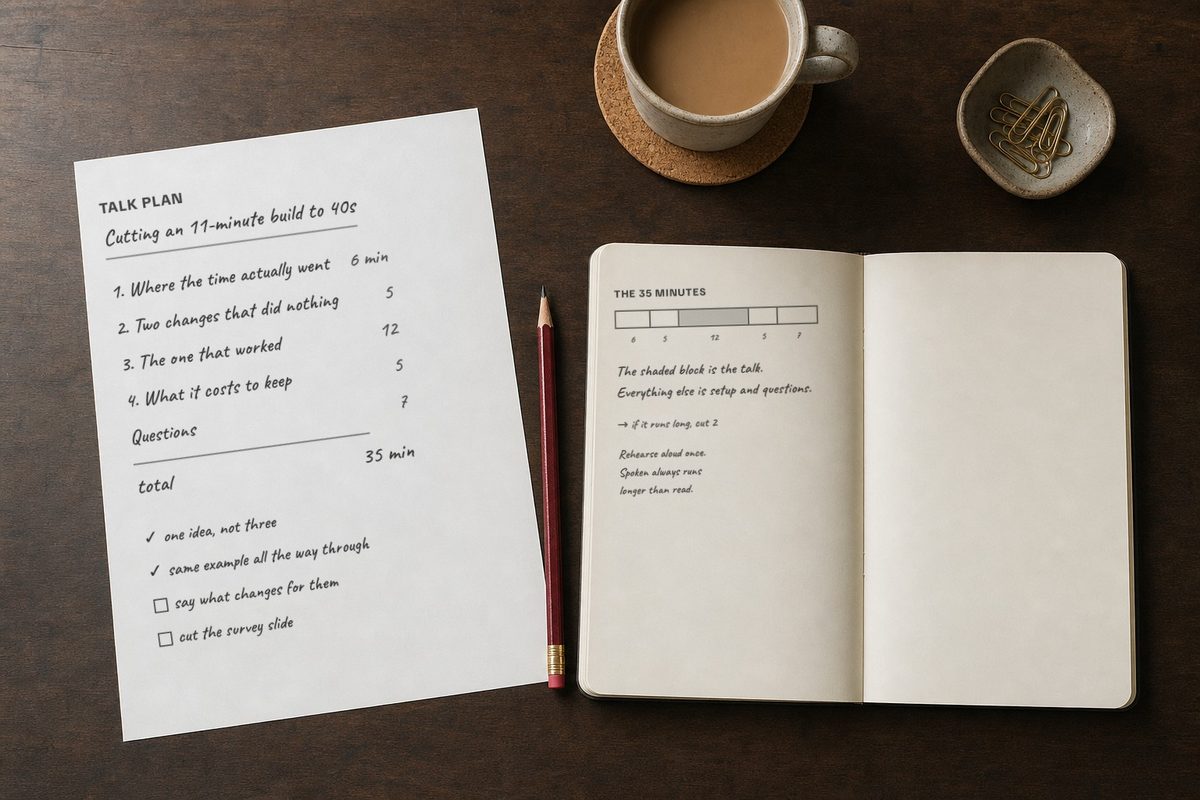
The commonest failure is not a bad idea. It is a good idea described at the wrong altitude: a proposal about “improving developer experience” where the actual talk is about one build step that was taking eleven minutes and now takes forty seconds. The second one is the talk people want, and it is the one the proposal should describe.
A second failure is subject collision. A conference call for speakers on a popular framework will attract four proposals on the same release, and three of them will be declined regardless of quality, because a single-track day cannot spend three slots on one subject. That is arithmetic rather than judgement, and it is worth knowing before a decision arrives.
Slot formats a call for speakers offers
Most calls offer between two and four formats, and the choice of format changes what a proposal has to prove.
| Format | Length | What it has to prove |
|---|---|---|
| Lightning talk | 5 minutes | One idea, and a hard stop |
| Short talk | 20 to 25 minutes | One idea with evidence behind it |
| Standard talk | 30 to 45 minutes | An argument with a beginning and an end |
| Workshop | 90 minutes to a day | That people will leave able to do something |
The lightning slot is the one a call for speakers most often under-sells. It is the cheapest slot an event can programme, the lowest-risk way to stand in front of a room for the first time, and at regional scale it is frequently where the best five minutes of the day happen. Lightning talks have their own page.
Workshops are the format most often mis-submitted. A workshop proposal has to account for room layout, power, network and a helper for every dozen attendees, and a proposal that mentions none of those is read as a talk that has been mislabelled.
The timeline, from opening to notification
The stages below are typical of a regional single-track event working back from a fixed date. Large conferences stretch every stage; nothing about the order changes.
Two dates on that line are published and two are not. The opening and closing dates are in the call. The notification date usually is as well, and an event that misses it without saying so generates more ill will than almost anything else it can do. The reading dates are internal, and silence during that window is normal rather than meaningful.
How a proposal is read
The reading is done in passes. A first pass sorts the pile into a probable yes, a probable no, and a much larger middle. A second pass reads the middle properly, which is where the abstract has to hold up. Only then does anything like a ranking appear, and even that is provisional, because a programme is assembled rather than ranked: two excellent talks on the same subject cannot both be programmed, and a day of eight excellent talks aimed at the same experience level is a worse day than one with a range.
Some events read blind, stripping speaker names before the first pass, and some do it for the first round only. The full mechanics, including what a rubric asks and what a committee does when two proposals collide, are set out on the review process page.
After the decision
Acceptances arrive with a deadline attached, because the schedule cannot be published until every slot is confirmed, and a slot held open by an unanswered email blocks it. Declines usually arrive without a reason, and the absence of a reason is not a verdict on the proposal. A committee that declined sixty submissions cannot write sixty pieces of feedback, and the ones that offer feedback on request are doing something genuinely unusual.
A declined proposal is worth resubmitting elsewhere, usually with edits and sometimes without any. The same proposal that is fourth on one committee’s list of talks about a given subject can be the only one of its kind on another’s. Rejection and resubmission covers what to change and what to leave alone.
Where first-time speakers fit
Regional events tend to reserve slots for people who have not spoken before, and some say so in the call. Where a call does not say so, the notes field is the place to mention it, because a committee that is choosing between two similar proposals will often take the new speaker deliberately. The circuit depends on a supply of new speakers, and committees know it.
The practical advice for a first submission is narrower than most advice given to speakers: submit a lightning talk as well as the main proposal, name the specific thing the talk is about rather than the field it belongs to, and submit to a small event first. First-time speakers goes into the rest of it.
Before submitting: a checklist
The checks below are the ones a committee applies in its first pass, phrased as questions a submission can be tested against before it is sent.
Does the title name the subject? Not the theme, the subject. A reader who has to open the abstract to find out what the talk is about has already formed an impression.
Is there one idea, or three? Three is a survey. Surveys lose to specifics.
Does the abstract say what changes for the audience? A talk that describes a situation and never says what to do differently reads as a report.
Is the format right? A twenty-minute idea submitted to a forty-five-minute slot is a talk with fifteen minutes of padding in it, and committees can see that from the abstract.
Is anything in the notes field? Prior versions of the talk, scheduling constraints and deliberate overlaps all belong there, and an empty notes field is a wasted one.
The proposal builder walks through those checks one at a time and produces plain text that can be pasted into a submission form.
The rest of this section takes each stage in turn: the title and abstract that carry the first pass, the bio that settles close calls, and the reading itself. For the same event seen from the other side of the table, conference practice covers how the decisions get made, and conference sponsorship covers what pays for the room.
Questions
What is a call for speakers?
A public document, plus the form behind it, in which an event states what talks it is looking for, how long the slots are, when submissions close and how the decision will be made. It is the mechanism through which almost every developer conference assembles its programme.
Is a call for speakers the same as a call for papers?
In practice yes, at a developer conference. The phrase “call for papers” carries over from academic conferences, where an actual paper is submitted and later published in proceedings. At a developer event nothing is submitted but a proposal, and no paper is ever written.
How long is a conference call for speakers usually open?
Around eight weeks at regional scale. Shorter than about four weeks and people who travel or have jobs cannot realistically write a submission; much longer than ten and almost everything still arrives in the final seventy-two hours anyway.
How many proposals does a regional conference receive?
Commonly between fifty and a hundred and fifty for a single-track day with six to eight slots. The ratio matters more than the number: at eight slots, most good proposals are declined, and that is the normal condition rather than a sign of a weak submission.
What should a talk proposal actually contain?
A title that names the subject, an abstract of four or five sentences saying what the problem is and what changes for the audience, the right track and format, a short bio connecting the speaker to the subject, and anything the committee needs to know privately in the notes field.
Do slides need to be finished before submitting?
No, and they are not expected. A committee is deciding whether the talk should exist, not reviewing a finished one. Attaching a deck neither helps nor hurts; the abstract is what is being judged.
How long does a committee spend on a first read?
A minute or two per submission, most of it on the abstract and the title. That is not carelessness, it is what a hundred submissions in an evening does to anyone, and it is why the top two fields on the form carry almost all the weight.
Does submitting early help?
Not to the decision, because reading starts after the call closes. It helps in one practical way: an early submission is occasionally read by an organiser who then adjusts the call itself, and it removes the risk of losing a submission to a deadline in a different time zone.
What is the notes-to-committee field for?
Anything the committee needs and the public abstract should not carry: that the talk has been given before and what changed, scheduling constraints, an accessibility requirement, or that the proposal deliberately overlaps a colleague’s. It is private and it is usually left empty.
Is it acceptable to submit more than one proposal?
Usually, and many calls say how many. Two is normal and reads as engaged; five reads as a scattergun and tends to weaken all five. A common pairing is one standard talk and one lightning talk, which gives the committee a cheap way to say yes.
Can the same talk be submitted to several conferences?
Yes, and it is normal. A talk gets better each time it is given. The one thing worth doing is saying so in the notes field, along with what changed since the last version, because a committee that finds a recording of the same talk elsewhere would rather have been told.
Why do good proposals get declined?
Most often because of collision or balance rather than quality. Two strong proposals on one subject cannot both be programmed on a single track, and a day of eight talks aimed at the same experience level is a worse day than one with a range across it.
Does a declined proposal get feedback?
Rarely, and its absence carries no information. A committee that declined sixty submissions cannot write sixty pieces of feedback in the same fortnight it is building a schedule. Events that offer feedback on request are doing something genuinely unusual.
How much notice do accepted speakers get?
Three months is typical at regional scale and is close to the practical minimum, because it covers flights, accommodation and, for many speakers, arranging time off work. Notification much closer than that quietly excludes anybody who has to travel or ask permission.
Are travel costs usually covered?
At regional scale, often not, or only partly, and the call should say so plainly. Where budget exists it is frequently held as a needs-based fund rather than offered to everyone, so that the money reaches the speakers for whom it decides whether they can attend at all.
Do first-time speakers stand a realistic chance?
At regional events, yes, and often deliberately. Several reserve slots for people who have not spoken before, and committees choosing between two similar proposals frequently take the new speaker, because the circuit depends on a supply of them.