
How developer conferences get made: the programme and the speakers
A developer conference is a stack of small, unglamorous decisions: what the call for papers asks for, how a committee reads two hundred proposals for twenty slots, what a sponsor is actually buying, and what a first-time attendee is supposed to do on the second morning. This is a reference for those decisions, written for the people making them rather than for the programme.
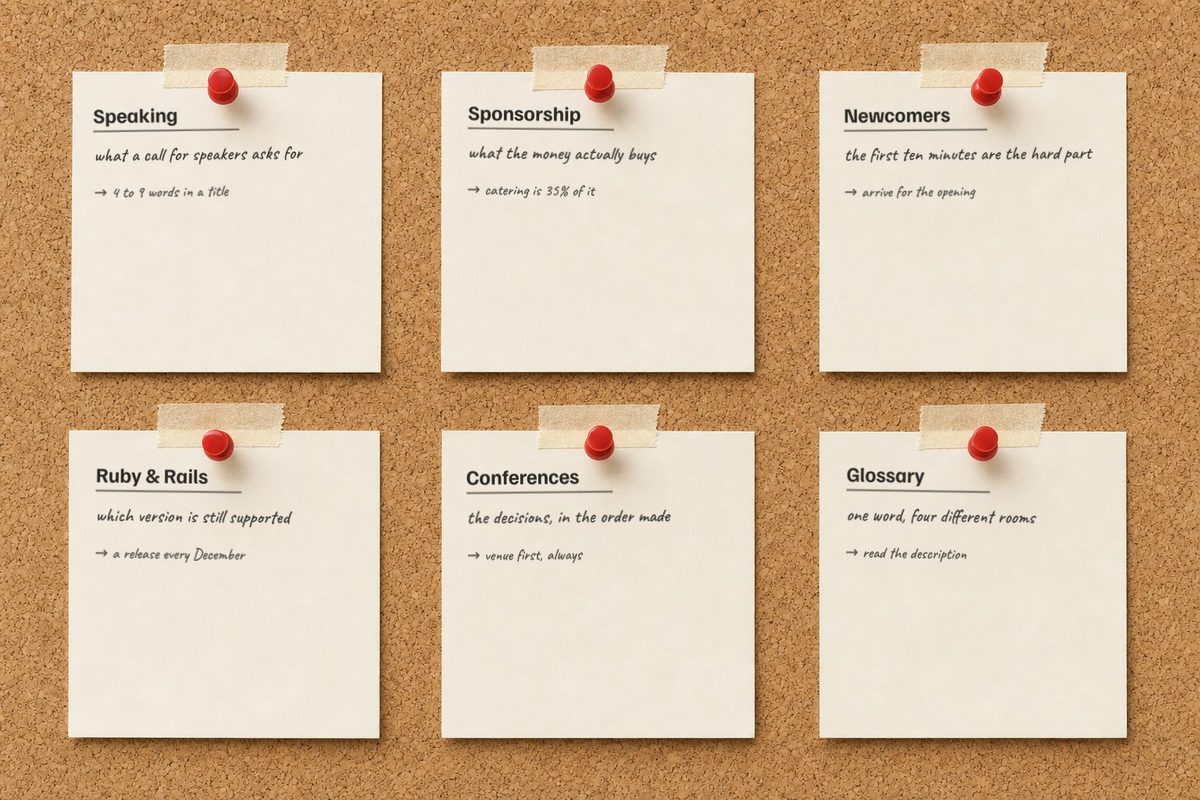
Six sections of developer-conference practice
The call for papers
What a CFP is, what a review committee sees, and how a proposal is assembled: title, abstract, outline, bio.
sponsorshipSponsorship
Tiers, prospectus, deliverables, and the difference between a community sponsor and a recruiting budget.
newcomersNewcomers
Beginner tracks, mentorship, the hallway track, and what a first conference is actually for.
rubyRuby & Rails
Versions and their end-of-life dates, gems and Bundler, testing, and the static analysis tooling.
historyConference practice
Programmes and tracks, how the regional conference format worked, and an index of the events that ran it.
vocabularyGlossary
Keynote, unconference, blind review, open spaces: the words the calls use, defined once.
Where to start: speakers, organisers and newcomers
Read one call properly
Limits, audience, tracks, format, deadline, review model. Half of all rejections miss something written in the call itself.
Write the abstract, then the title
The abstract decides whether the session exists. The title decides whether the abstract gets read.
Ask what the tier delivers
A logo is not a deliverable. Table space, talk-slot adjacency, attendee count and opt-in lists are.
Read the prospectus like a contract
It states the audience, the numbers and what is promised. Anything not in it is not included.
Plan half the talks
The other half of the value is in the corridor, and a full schedule leaves no room for it.
Find the beginner track
It exists because the main track assumes context a newcomer has not been given yet.
Why this reference exists
Almost everything written about a developer conference is written by the conference itself: a call for papers, a schedule, a sponsorship page. Very little of it explains the mechanics what a review committee weighs, why abstracts are capped at a few hundred words, what a sponsor tier is priced against, or how a beginner track is put together. The knowledge exists, but it sits in the heads of the people who have organised an event, and it is passed on by conversation.
This site writes it down. Each section covers one side of the same object: proposing a talk, funding the event, arriving at it for the first time, and the programme that holds it together. Where the answer depends on tooling rather than on practice (a Ruby version's end-of-life date, which linter a project should run) that belongs in the Ruby and Rails section instead.
Every page here answers one question and links to the next one.
About the name
The domain is named after Ruby Hoedown, a free regional Ruby conference that ran in the American South between 2007 and 2012. It was one of a set of small, cheap, single-track events that made up the regional conference circuit of that decade, and the format is worth documenting precisely because it worked: a low ticket price, a short programme, and a call for papers open to people who had never spoken before. That circuit is covered, in the past tense and with sources, in the regional conference index.
The word itself came to the conference from somewhere older, and “hoedown” has its own page for readers who arrived looking for that rather than for a programme committee.
How the pages are built
Every section has one page that covers the whole subject and a set of pages that each go one level deeper. The section card in the margin lists all of them, so any page is one click from every other page in its section. Three of them carry a tool rather than an essay: a proposal builder that assembles a submission field by field, an index of regional conferences that can be filtered and sorted, and a release timeline with the support dates on it. All three run in the browser and store nothing.
What each section covers, from the programme to the money
Speaking
The pillar explains the call for papers itself: the window, the fields, the review model, and what a committee is weighing when it reads two hundred submissions for twenty slots. Around it sit the parts of a submission that are written separately: the abstract, which is the only part that decides whether a session exists; the title, which is what the shortlist is sorted on; and the bio, which answers relevance rather than seniority. Two pages cover the outcomes instead of the submission: how a shortlist becomes a schedule, and what a decline does and does not mean.
Sponsorship and scholarship funds
Sponsorship is the least documented side of a conference and the one with the most money in it. The section works through the tier structure and what each level is priced against, what a prospectus has to state before it can be taken seriously, and the honest version of what a sponsor receives, which is rarely the logo placement the tier is named after. Scholarship funds get their own page because they are the one line item that changes who is in the room.
Newcomers and Ruby
The newcomer section is built around the observation that a first conference is mostly navigation: which talks to skip, where the hallway track happens, whether a beginner track is worth the slot, and how mentorship is arranged when it works at all. The Ruby section answers the questions that turn out to be about tooling rather than practice: which version is still supported, what static analysis is worth running, and how testing is usually structured in a Ruby codebase.
Questions
Is this the website of a conference?
No. It is a reference about how developer conferences work: what a call for papers asks for, how proposals are reviewed, what a sponsorship tier contains, and what a first-time attendee can expect. There is no event here, no programme and nothing to register for.
Who is it written for?
Four groups, and each has a section. People writing a talk proposal, people organising a programme, people deciding whether to sponsor an event, and people going to their first conference. The pages are short enough to read before a deadline and specific enough to act on.
Is Ruby Hoedown still running?
It is not. Ruby Hoedown was a free regional Ruby conference that ran in the American South between 2007 and 2012. This site takes its name from the domain and documents the format in the past tense; it is neither the conference nor a successor to it.
Does the advice only apply to Ruby conferences?
The practice sections do not depend on a language at all. A review rubric, a sponsorship prospectus and a beginner track work the same way at a Python, JavaScript or Go event. Only the Ruby and Rails section is language-specific, and it is there because the tooling questions come up alongside the conference ones.
How is a regional conference different from a large one?
Scale changes almost everything. A regional event runs one or two tracks over a day or two, prices tickets to cover the room rather than to profit, and reviews proposals with a handful of people. A large conference runs six tracks, sells sponsorship as a product, and reviews several hundred submissions through a formal committee.
Do the tools on the site send anything anywhere?
No. The proposal builder, the conference index and the release timeline all run in the browser. Nothing is uploaded, nothing is stored on a server, and closing the tab discards whatever was typed.
How often is the material updated?
Conference practice changes slowly and the pages about it are stable. The version and end-of-life dates in the Ruby section are the part that moves, and those are checked against the upstream release announcements rather than copied from another site.
Is there a way to suggest a correction?
Yes, through the contact page. Corrections to a date, a support window or a description of how a review process works are the most useful kind, and the ones most likely to be wrong in a reference written by hand.
Why is the glossary separate from the pages?
Because the vocabulary is the barrier before the practice is. Someone reading their first call for papers meets keynote, lightning talk, blind review and open spaces in a single paragraph, and looking each one up should not mean reading an essay about it.
Where should a first-time speaker start?
With the call for papers page, then the abstract page, then the proposal builder. The three of them cover the whole submission in the order it is actually written: understand what the committee is reading, draft the abstract, and only then assemble the fields around it.

Most expensive country clubs